ROSS Polymer Services is a contract manufacturing company specialising in technical injection moulding and value-added assembly for highly regulated sectors, including medical, life sciences, semiconductor, and food packaging production. With extensive expertise in advanced polymer processing, the company delivers innovative manufacturing solutions by leveraging state-of-the-art technologies and the latest material developments. Working in close partnership with its customers to translate complex technical requirements into robust, scalable products.
Committed to sustainability and regulatory compliance, ROSS is at the forefront of developing reusable, food-contact-safe packaging solutions. Through material innovation and process optimisation, the company is actively supporting the transition away from single-use coated paper-based and plastic packaging towards durable, circular alternatives.
Reusable packaging
In response to evolving EU Packaging and Packaging Waste legislation, reusable packaging has emerged as a key strategy for reducing single-use packaging in the HoReCa sector. While reusable plastic packaging is already in use, significant technical and regulatory uncertainties remain, particularly regarding the safe incorporation of recycled materials in food-contact applications.
For ROSS Polymer Services, the core challenge was the absence of application-specific evidence demonstrating whether recycled polypropylene (rPP), and in particular post-industrial recycled PP (PIR PP), could meet the performance, safety, and regulatory requirements of reusable food-contact packaging. Existing regulatory approvals and published studies focus largely on virgin polymers or PET recycling technologies, leaving a critical knowledge gap around the behaviour of recycled PP under repeated real-world use conditions.
Key unknowns included the impact of repeated heating, contamination, washing, and decontamination cycles on material durability, chemical migration, microbial safety, aesthetic performance, and traceability. Without this data, it was not possible to confidently progress toward commercially viable reusable packaging solutions incorporating recycled content.
APT Technology Gateway Collaboration
ROSS Polymer Services worked in collaboration with APT Technology Gateway, through an Enterprise Ireland IPP Feasibility Study, to establish baseline performance, screen suitable recycled PP grades and systematically assess their safety and durability under simulated reuse conditions representative of HoReCa applications.
The key problem areas addressed within this feasibility study were:
- Establishing baseline mechanical, thermal, chemical, and microbial performance of virgin polypropylene used in reusable packaging
- Identifying food-contact-safe recycled polypropylene grades suitable for injection moulding
- Assessing the impact of repeated heating, washing, and reuse cycles on material durability and safety
- Evaluating chemical migration compliance for recycled PP in food-contact applications
- Validating microbial decontamination effectiveness following repeated use
- Assessing the robustness of traceability features (QR code marking) under reuse conditions.
Following initial technical discussions with ROSS Polymer Services, the Applied Polymer Technologies (APT) team worked closely with the company to define the key technical unknowns limiting the development of reusable food-contact packaging incorporating recycled materials. A structured feasibility study plan was agreed, ensuring that all testing and validation activities were aligned with real-world HoReCa use conditions and relevant regulatory requirements.
APT first established baseline performance data for the virgin polypropylene grades currently used by ROSS Polymer through comprehensive thermal, mechanical, chemical, and microbial characterisation. This baseline provided a benchmark against which potential recycled materials could be assessed. In parallel, APT supported the identification and selection of a suitable post-industrial recycled polypropylene (PIR PP) grade with food-contact potential, informed by regulatory considerations and material traceability.
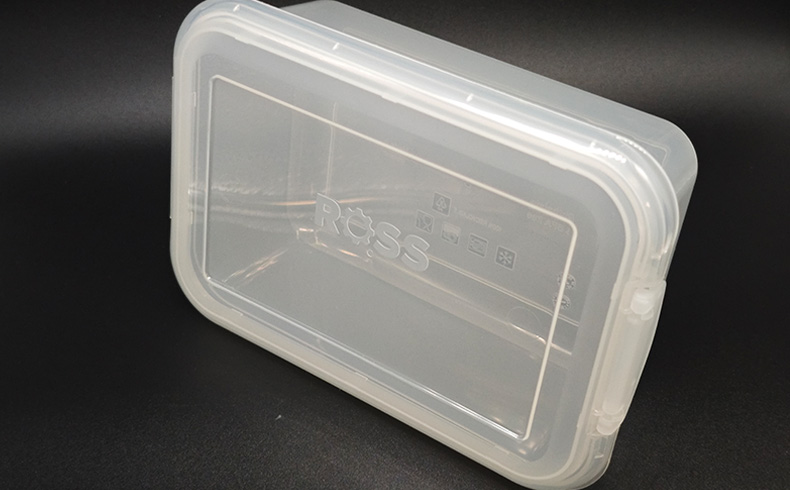
Prototype reusable containers were then produced by ROSS Polymer via injection moulding, using both virgin and recycled PP grades. APT designed and executed simulated reuse protocols representative of real-life application conditions, including repeated heating, food contamination, and industrial dishwashing cycles. The prototypes were systematically evaluated before and after simulated reuse to assess changes in mechanical performance, thermal stability, chemical migration, aesthetic appearance, QR code traceability, and microbial safety.
APT also led chemical migration testing in line with EN 1186 standards and conducted microbial challenge and decontamination studies to validate food safety over repeated use cycles. Throughout the project, results were reviewed jointly with ROSS Polymer to ensure findings were commercially relevant and directly applicable to future product development.
The project concluded with the delivery of a comprehensive feasibility report outlining the technical findings, validated methodologies, and clear recommendations for next development steps. This work provided ROSS Polymer with the evidence base required to de-risk the use of recycled polypropylene in reusable food-contact packaging and to inform progression toward a full Innovation Partnership project.
Impact on the Company
This feasibility study had a significant strategic and technical impact on ROSS Polymer Services by providing the company with robust, application-specific evidence to support the development of reusable food-contact packaging solutions incorporating recycled materials.
Through collaboration with APT, ROSS Polymer gained a detailed understanding of how its existing virgin polypropylene materials perform under repeated real-world use conditions, establishing a critical performance baseline for future product development. The study also enabled the company to confidently assess the suitability of post-industrial recycled polypropylene for reusable food-contact applications, an area previously constrained by regulatory uncertainty and lack of validated data.
The findings de-risked key aspects of material selection, food safety, and durability, allowing ROSS Polymer to make informed decisions regarding sustainable material adoption and product design. In addition, the validation of cleaning protocols, chemical migration compliance, and traceability performance strengthens the company’s ability to assure customers and regulators of the safety and reliability of its reusable packaging offerings.
Michael Hopkins, Ross Polymer Services stated that “Applied Polymer Technologies (APT) were a key partner on our innovation project. Their strong understanding of industry requirements, combined with a solid research-led approach, ensured practical, well-informed solutions that aligned with real manufacturing challenges. A highly professional and knowledgeable team to work with.”
By leveraging APT’s expertise in polymer characterisation, food-contact compliance, and reuse testing, ROSS Polymer is now positioned to accelerate the development of circular, reusable packaging, support customer sustainability goals, and progress toward a market ready solution with reduced technical and commercial risk.
Read the full research article here.
To find out more about the APT Technology Gateway check out their web page and connect on LinkedIn.