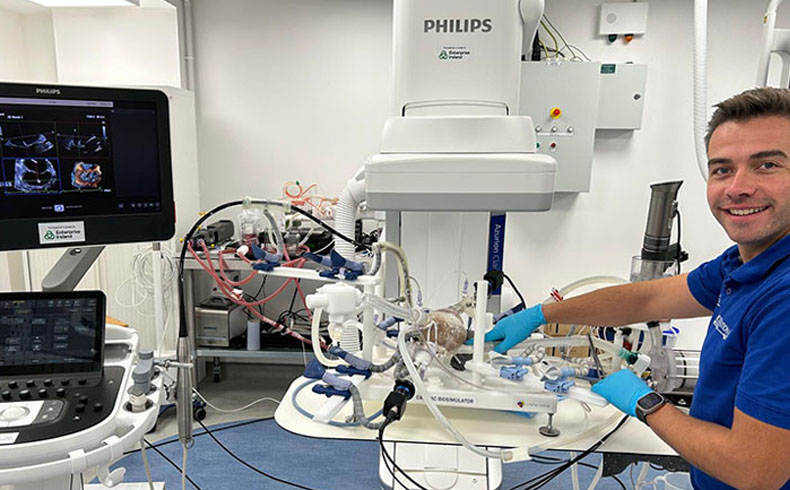
As part of our ‘Meet the Team’ series, we’re sharing interviews with members from across the Technology Gateway Network. Today, we’re pleased to introduce Cliodhna Carroll, Business Development Lead at PEM Gateway, ATU Sligo.
Can you introduce yourself and tell us about your role in PEM Technology Gateway?
I’m the Business Development Lead at the PEM Technology Gateway based in ATU Sligo. My role is focused on connecting industry with applied research, working with businesses of all sizes, from startups and micro-enterprises to SMEs and multinational companies, to identify where innovation can solve real challenges and create new opportunities. I then help translate those opportunities into practical R&D projects with our engineering team.
A big part of what I do is building relationships and understanding what companies are trying to achieve, where their challenges lie, and how PEM can support them on their innovation journey. Whether it’s research and development, product design, materials testing, process improvement, or exploring a new idea, my focus is on helping businesses access the expertise, facilities, and support they need in a way that’s both technically strong and commercially relevant.
What does a typical day look like for you?
There isn’t really a “typical” day, which is part of the appeal. It’s usually a mix of engagement with companies, internal project discussions, and exploring new opportunities.
One day I could be meeting a manufacturer about process improvement, product design optimisation, or materials research and testing; the next I’m working with colleagues on developing a proposal or scoping a new project. I also spend a lot of time building relationships and supporting businesses at different stages of their growth journey, from startups and micro-enterprises to established SMEs and multinational companies.
A key part of my role is helping organisations understand how innovation and applied research can support their ambitions, whether they’re developing a new product, solving a technical challenge, or exploring opportunities for future growth. There’s also a constant focus on building partnerships, with industry, colleagues at the Atlantic Technological University and across the wider Technology Gateway network.
What emerging technologies or trends are you most excited about in your field?
What excites me most is seeing how companies are embracing innovation to stay competitive, whether that’s through developing new products, improving existing ones, or exploring new materials and manufacturing processes.
I’m particularly interested in advances in material analysis and testing, sustainable materials, and the growing emphasis on designing products with performance, manufacturability, and sustainability in mind from the outset.
It’s also encouraging to see more companies recognising the value of R&D as part of their long-term strategy, not just for solving immediate problems, but for identifying new opportunities and creating future growth.
What industries or sectors do PEM commonly work with?
We work across a broad range of engineering and manufacturing sectors, including precision engineering, medtech, construction products, plastics, and general manufacturing.
A lot of our work is with Micro businesses, SMEs, and we also collaborate with larger and multinational companies. What they tend to have in common is a need to solve a technical challenge, improve a process, develop a new product, or explore an opportunity they don’t have the in-house capacity or expertise to progress fully.
One of the unique benefits of working with PEM is access to our specialist equipment, machinery, facilities, and technical expertise. Companies can use our facilities to test new processes, develop prototypes, manufacture sample components, evaluate materials, and validate concepts before making significant investment decisions.
Many companies use PEM as a “test-before-you-invest” environment. For example, a business considering investing in new manufacturing equipment or technology can use PEM’s facilities to trial the process, assess feasibility, and demonstrate capability to customers before committing capital expenditure. This allows them to reduce risk, build confidence in the business case, and make more informed investment decisions.
In many cases, companies can undertake the research, development, testing, and proof-of-concept work with PEM first, ensuring they are making the right investment at the right time. This practical, hands-on approach helps businesses innovate with greater confidence while reducing the risks often associated with adopting new technologies, equipment, or processes.
Can you describe what an initial client engagement looks like?
It usually starts with a conversation. A company will come to us with a challenge or an idea, and we take the time to really understand what they’re trying to achieve.
From there, we’ll involve the relevant technical expertise within PEM to assess feasibility and shape a potential solution. That often leads into a defined R&D project with clear objectives, timelines, and outcomes.
The key at that early stage is making it practical, breaking things down into manageable steps and ensuring there’s a clear pathway forward.
What are some common challenges companies face when starting an R&D project, and how does PEM help overcome them?
One of the biggest challenges is uncertainty, companies often know they need to innovate but aren’t sure where to start or what approach to take.
There can also be constraints around time, resources, and risk. R&D can feel like a big commitment, particularly for SMEs.
That’s where we add value. We help de-risk the process by providing technical expertise, structured project approaches, and access to facilities and equipment. We also help define the scope properly from the outset, which avoids a lot of issues later.
Can you share a recent project or success story that highlights PEM’S impact?
A lot of the work we do focuses on helping companies improve processes, whether that’s increasing efficiency, reducing waste, or developing a new capability.
For example, we’ve worked with companies to introduce automation into manual processes, helping them scale more effectively. In other cases, it’s about validating a new product concept or improving manufacturing consistency.
The biggest impact is often in giving companies the confidence to take the next step, moving from an idea to something tangible.
We were delighted to recently collaborate with MMG Ocean, Killybegs and Ocean Kinetics, Shetland on this innovative engineering project through the PEM Technology Gateway.
This project is a great example of how industry and applied research can work together to solve real-world challenges. By combining industry knowledge with PEM’s engineering expertise, the team successfully redesigned a pig insertion trolley for offshore pipeline operations, improving operator safety, usability and performance while meeting the demanding constraints of the offshore environment.
Collaboration projects like this demonstrate the value of applied R&D in helping companies overcome technical challenges, develop new solutions, and create opportunities for future growth and commercialisation.
This project is an excellent example of how PEM helps companies overcome technical challenges, accelerate innovation, and develop competitive solutions through targeted applied R&D support.
What are the main benefits for a company collaborating with PEM and the wider Technology Gateway network?
Access to expertise is a major one, companies can tap into a multidisciplinary team without having to build that capability in-house.
There’s also access to facilities, equipment, and the wider Technology Gateway network across Ireland, which means we can bring in the right expertise where needed.
Importantly, the model is designed to be industry-focused and practical. It’s about delivering outcomes that have real commercial value, not just research for its own sake.
What advice would you give to companies looking to future-proof their business through innovation?
Start early and keep it practical. Innovation doesn’t have to mean large, high-risk projects, it can be incremental improvements that build over time.
Engage with the right partners, and don’t be afraid to explore ideas before you fully commit. The earlier you test and validate concepts, the better your decisions will be.
And importantly, make space for it internally. Innovation won’t happen if it’s always competing with day-to-day operational pressures.
How can a business connect with PEM?
The easiest way is to get in touch directly through our website, LinkedIn, or by reaching out to the team.
We’re always happy to have an initial conversation, even if a company is only at the idea stage or simply exploring whether innovation could help address a challenge or opportunity.
We also encourage companies to visit PEM and see our facilities for themselves. We have an open-door policy and welcome anyone with an interest in innovation, whether they’re actively developing a project or simply curious about how applied research could benefit their business. Sometimes the best place to start is with a conversation and a tour.