As manufacturing continues to push the boundaries of complexity, customisation and performance, precision engineering has become a key enabler of innovation. One of the clearest examples of this shift is the growing use of simultaneous 5‑axis CNC machining, a technology that allows manufacturers to produce components that would have been extremely difficult (if not impossible) using more traditional methods.
Moving Beyond Traditional Machining
Conventional 3‑axis CNC machining restricts tool movement to linear paths. While effective for simpler parts, this often means multiple setups are needed to machine different faces of a component. Each setup adds time, cost and the risk of tolerances stacking up.
5‑axis machining changes this completely. By allowing the cutting tool to approach the part from almost any angle in a single setup, it delivers higher accuracy, better consistency, and far greater design freedom. This capability has become increasingly important in sectors where complex geometries, tight tolerances, and high performance are non‑negotiables. Industries such as medical devices, aerospace, automotive, mould and toolmaking and automation now rely heavily on 5‑axis machining to meet demanding technical and regulatory requirements.
Machining Complex Geometry with Confidence
One of the standout advantages of advanced 5‑axis machining is its ability to produce complex, multi‑surface and undercut features with confidence. Curved profiles, deep cavities, and compound angles can all be machined accurately and repeatably, often removing the need for secondary processes like EDM or manual finishing.
High‑speed spindles further enhance this capability, delivering excellent surface finishes and reliable dimensional accuracy. In many cases, parts come off the machine ready for testing, validation, or direct use – saving valuable time in the production process.
Efficiency Through Single‑Setup Machining
Machining multiple faces in a single setup has a major impact on efficiency. Reduced setup time means shorter lead times, fewer opportunities for error, and improved repeatability. These benefits are particularly significant in prototyping and low‑volume production, where flexibility and speed are critical.
For companies bringing new products to market, this efficiency can provide a real competitive advantage. Faster turnaround times support quicker design iterations and help reduce the overall development cycle.
The Importance of Advanced CAM Software
Modern 5‑axis machining relies just as much on software as it does on machine hardware. Advanced CAM systems allow engineers to create optimised toolpaths that improve cutting efficiency while protecting both tooling and equipment. Features such as collision detection, adaptive machining strategies, and precise control over tool engagement are essential when working with complex 3D surfaces.
When integrated effectively, high‑performance CAM software delivers consistent quality, shorter cycle times, and reliable, repeatable results – key requirements in regulated or performance‑critical industries.
Collaboration Beyond the Machine Shop
Precision engineering is not just about machining parts. Increasingly, engineering teams are working closely with customers to improve designs for manufacturability, develop bespoke fixtures and jigs, and support research and development projects. This collaboration helps identify and solve potential issues early, reducing the risk of costly changes later in the product lifecycle.
For SMEs and startups in particular, access to this kind of engineering support can be invaluable. It allows them to validate new ideas and scale production without needing extensive in‑house manufacturing resources.
Building Stronger Manufacturing Capability
As manufacturing demands greater speed, accuracy, and accountability, precision engineering has evolved from a supporting role into a strategic capability. The combination of advanced 5‑axis machining, intelligent CAM software, and skilled engineering collaboration is transforming how products are designed and developed.
Organisations that invest in these capabilities are better positioned to innovate quickly, compete internationally, and deliver high‑value products across a wide range of sectors.
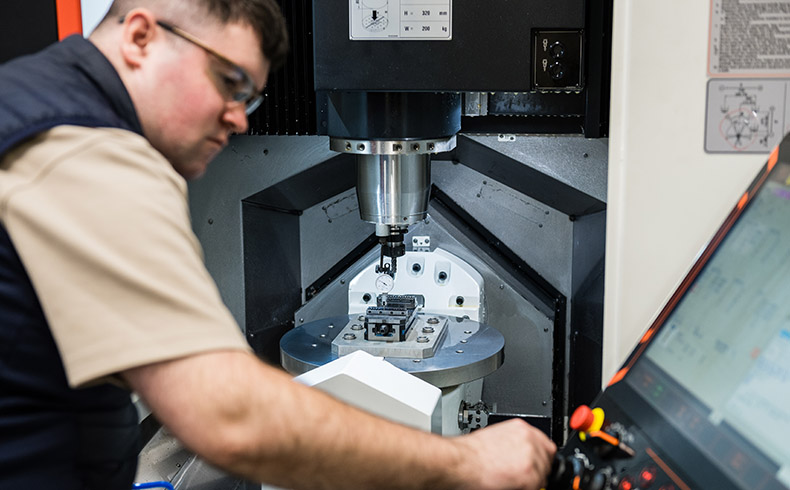
Mazak CV5 500 5 Axis CNC Milling at PEM Gateway
The advanced 5 Axis CNC machining capabilities at PEM Technology Gateway, ATU Sligo enables industry partners to realise complex, high precision components with exceptional accuracy and efficiency. Funded by the Enterprise Ireland Capital Equipment Call and powered by the MAZAK CV5 500 and hyperMILL CAM software, PEM is well positioned to support engineering and manufacturing companies nationwide by speeding up product development, improving manufacturability and boosting overall production performance.
To learn more about how PEM can support your business, get in touch with the team or follow on LinkedIn.