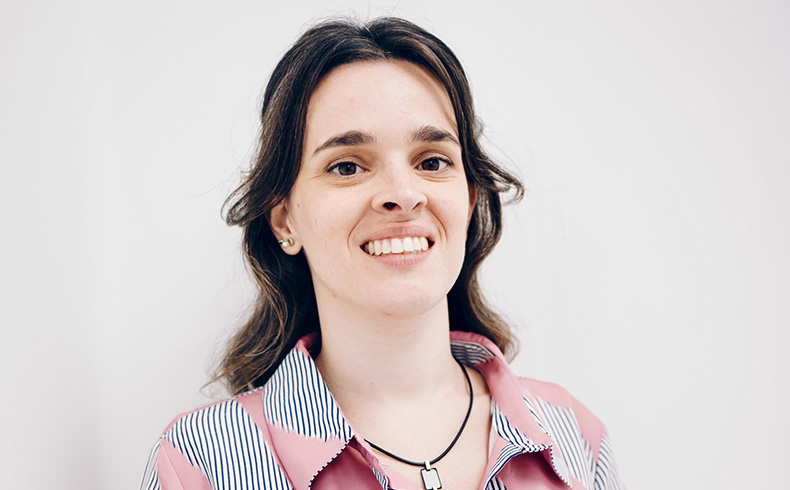
As part of our ‘Meet the Team’ series, we’re sharing interviews with members from across the Technology Gateway Network. Today, we’re pleased to introduce Mariana Semmoloni, Business Development Technologist at MiCRA Technology Gateway, TU Dublin.
Can you introduce yourself and tell us about your role in MiCRA Technology Gateway?
I’m Argentinian and I have been living in Ireland for a year and a half now. Here, I found serious institutional programs and infrastructure, like the Technology Gateways, designed to help companies solve technical challenges and move forward in their innovation programs. That’s the work I wanted to be part of.
I’m a plant biologist by training; I did my PhD in plant molecular biology and physiology. After that, I spent years in early-stage biotech and biomaterial startups, working very close to the founding team across alternative proteins, plant cell fermentation, sustainable textile fibres and microbiology. I’ve worn a lot of different hats: R&D, project management, troubleshooting, pivoting when needed.
Having worked in both academic and industry environments, I understand both worlds and I’m comfortable operating at their intersection. At MiCRA, I work as a Business Development Technologist. My role centres on two equally important areas. On the business development side, I work closely with companies to understand their strategic objectives and technical challenges, and I guide them through how we can help. On the technical side, I design the research roadmap, run the lab work, and manage the project delivery.
What does your schedule look like on a typical day?
No single day looks the same in this role, and I value that. On a typical day, I could be in the lab carrying out R&D work for our clients, in the office working on project planning, data analysis, reporting or meeting with clients, scientific advisors and suppliers, or outside MiCRA participating in site visits, conferences and exhibitions.
A significant part of my work involves connecting the dots to ensure each project has access to the expertise and capabilities it needs. MiCRA’s comprehensive capital equipment is a significant advantage, but we also strategically connect with specialist suppliers and collaborators to tailor our offering to each project’s specific requirements.
What inspired you to get involved in RD&I?
My path into RD&I was not a deliberate decision made in advance; it unfolded as I progressed through my career. After finishing my PhD, I worked in early-stage startups. That is where I saw Research, Development and Innovation connect in practice. That is also where I became aware of the different mindset needed in applied research, and the wider vision needed to take scale-up, manufacturing integration, IP, regulatory requirements, and market fit into accountt. I wanted to understand these strategic aspects more deeply, and that’s why I pursued the specialization in Technology and Innovation Management.
I believe applied research creates a competitive advantage for companies, and that science and technology-driven innovation are drivers of economic resilience and growth. Technology Gateways work exactly at that intersection, so I couldn’t be prouder to be part of MiCRA.
What are the key stages of a typical MiCRA client engagement?
Companies reach us through various routes. Some come from informal conversations at conferences or networking events, and then follow up later. Others contact us directly via email or LinkedIn. We also receive clients through recommendation from previous collaborators or prior clients, and often companies are directed to MiCRA through internal TU Dublin pathways. However they arrive, the first step is always the same: we have initial conversations to understand what they’re trying to solve.
Once we understand the challenge, we work with the company to scope out a tailored solution. This can involve some back and forth as we align on what they need and what we can offer. For projects funded through an Innovation Voucher, which is a common entry point, we then move into a more formal project setup. We agree on clear objectives and deliverables, define the work structure, and outline how we’ll communicate throughout.
The project runs from there, typically over two months for a voucher-funded project, and closes with a final report that captures the results and learnings. It’s common for companies to continue working with us afterward, pursuing additional vouchers or longer-term collaborations as their innovation journey evolves.
In what ways are MICRA unique, especially in its impact across the Eastern region?
Technology Gateways are designed to support companies at every stage of their innovation journey. The value is straightforward: companies gain access to technical expertise and specialist equipment at minimal cost, which is crucial for de-risking R&D activities, particularly for SMEs that don’t have in-house research capacityor prior experience.
MiCRA brings its own distinctive strengths to that mission. We have a multidisciplinary team with deep expertise spanning agri-food technology, analytical testing, environmental analysis, diagnostics and material sciences. More than that, we have a comprehensive set of capital equipment that serves across all those areas. This means we can tackle complex, multi-faceted projects. We’re also a key member of the Irish Food Tech Cluster, working collaboratively with six other gateways to bring broader capabilities to companies in the food and beverage sector. That collaborative structure is valuable: when a project needs expertise beyond MiCRA’s immediate scope, we can bring in the right partners from across the Network.
What are some of the biggest innovation challenges Irish companies are currently facing?
Many companies have a clear sense of their market problem but struggle with the R&D pathway to solve it. Beyond the technical work, they also need to navigate intellectual property, regulatory compliance, and manufacturing integration.
Another common challenge is that many SMEs lack dedicated in-house R&D capacity. They can’t justify hiring a full research team, but they need credible proof their innovation works before investing further. Prototyping, testing and validation are crucial milestones to overcome that stage, but the infrastructure and knowledge isn’t always accessible.
How can MICRA help businesses turn an initial idea into a practical, viable solution?
We help translate a problem or idea into a structured R&D project. This starts with understanding what the business is trying to achieve and designing a project roadmap that works for it: defining the research questions, the work required, the timeline and desired outcomes.
From there, we can support businesses through exploration, prototyping, testing and validation, de-risking every step of the innovation process.
By its own nature, research involves uncertainty: you often don’t know exactly what you’ll find or where the work will lead. We help businesses navigate that uncertainty, collecting data we can build on.
Many companies start with an Innovation Voucher, which gives them access to two months of focused R&D at manageable cost. It provides a foundation to build from. Companies often return for additional vouchers or other collaboration forms to progress their innovation further.
If you could offer one piece of advice to a business exploring R&D for the first time, what would it be?
Engage early, even if you’re not yet clear on all the details. You don’t need to have everything figured out before you reach out. In fact, conversations with the technical team will provide clarity. Working together to define the right problem outline, the research questions, and expected outcomes is how you move from an initial idea to a well-focused project. Communication is crucial here.
As I mentioned earlier, uncertainty should be expected along the way, particularly in the early stages. A well-designed R&D project addresses this directly, and we can certainly help with that.
How can businesses connect with MiCRA?
There are two direct ways to connect with us: by email or through our LinkedIn page:
- mariana.semmoloni@tudublin.ie
- MiCRA – Technology Gateway | LinkedIn
That said, I’d like to encourage any business with an idea, open problem or questions to reach out. We are an open and dynamic team, we understand SMEs and industry times and we move to match their pace. We can help across all stages of the innovation cycle, and we can point companies in the right direction if we don’t have the technical capabilities they need. So please do reach out!