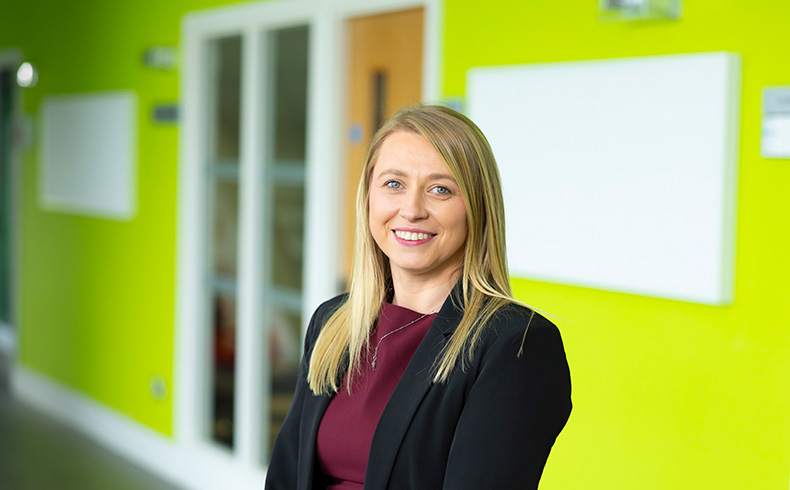
As part of our ‘Meet the Team’ series, we’re sharing interviews with members from across the Technology Gateway Network. Today, we’re pleased to introduce Melissa Doyle, Business Development Executive at ICS Technology Gateway.
Tell us a bit about your role in ICS Technology Gateway at Walton Institute
As a Business Development Executive within the ICS Technology Gateway at Walton Institute, my role centres on helping businesses access the expertise, research capabilities and innovation supports they need to grow and remain competitive.
I work closely with companies to understand their strategic objectives, operational challenges and opportunities for innovation. From there, I help identify how Walton Institute’s multidisciplinary research teams, technical expertise and facilities can support their goals through applied research and development.
A significant part of my role involves building strong relationships with industry and guiding companies through the various innovation supports available, whether that is through Innovation Vouchers, Innovation Partnership Programmes (IPP), Innovation Partnership Feasibility (IPF) funding or Contract R&D projects. Ultimately, my focus is on making innovation accessible and ensuring businesses can translate ideas into tangible commercial outcomes.
How does Walton Institute support businesses at different stages of their innovation journey?
One of Walton Institute’s strengths is its ability to support organisations at every stage of the innovation lifecycle, from exploring an initial concept through to product development, validation and commercialisation.
For businesses at the early stages of innovation, we help assess opportunities, evaluate technical feasibility and provide access to specialist expertise that may not exist within the organisation. Innovation Vouchers are often an excellent entry point for SMEs seeking to investigate a challenge or test a new idea in a practical and low-risk way.
For companies with more established R&D ambitions, we support larger-scale collaborative projects through programmes such as IPP, IPF and Contract R&D. These projects can involve developing new technologies, improving existing processes, validating solutions or accelerating routes to market.
Importantly, our approach is never one-size-fits-all. Every project is tailored to the individual needs, resources and objectives of the business involved.
What industries or sectors does Walton Institute commonly work with?
Walton Institute works with organisations across a diverse range of sectors, including manufacturing, healthcare, agri-tech, ICT, telecommunications, smart cities, transport, energy and financial services.
Our expertise spans areas such as communications technologies, artificial intelligence, data analytics, IoT, cybersecurity and digital transformation, allowing us to support businesses facing a wide variety of technological and operational challenges.
We work with both indigenous SMEs and multinational organisations, creating valuable opportunities for collaboration, knowledge sharing and innovation across sectors.
How does collaboration within the Technology Gateway Network enhance the support offered to clients?
The Technology Gateway Network provides a significant advantage for businesses because it offers access to expertise and facilities that extend well beyond a single organisation.
Innovation challenges are often complex and multidisciplinary in nature. Through collaboration across the Network, we can draw on specialist knowledge, research capabilities and sector expertise from across the country while maintaining a strong focus on industry-led, applied research.
For businesses, this means access to a broader innovation ecosystem, enabling them to identify the most appropriate expertise, funding mechanisms and collaboration opportunities to support their objectives and accelerate innovation outcomes.
What are some common challenges companies face when starting an R&D project, and how does Walton Institute help overcome them?
One of the most common barriers is uncertainty. Businesses often have questions around technical feasibility, costs, timelines, resource requirements and, quite simply, where to start.
This can be particularly challenging for SMEs that may have limited internal R&D capacity or may not be fully aware of the innovation supports available to them.
Our role is to help reduce that uncertainty by providing practical guidance, technical expertise and a collaborative framework for innovation. We work closely with companies to break projects into manageable stages, identify suitable funding supports and select the most appropriate engagement model for their needs.
By helping businesses test and validate ideas before making significant investments, we can reduce risk while ensuring projects remain commercially focused and aligned with strategic objectives.
What emerging technologies or trends are you most excited about in your field?
There are several developments that I find particularly exciting, especially the continued advancement of artificial intelligence, edge computing, IoT and data-driven automation.
What is perhaps most interesting is how accessible these technologies have become for SMEs. Businesses can now apply them in practical and impactful ways, whether through predictive maintenance, smart manufacturing, personalised healthcare solutions or intelligent decision-support systems.
There is also growing emphasis on trusted AI, cybersecurity and sustainable digital transformation. As organisations become increasingly connected and data-driven, these areas will play a critical role in building resilience, trust and long-term competitiveness.
How does Walton Institute tailor its approach to meet the unique needs of each business?
Every business operates within its own commercial context and has different levels of innovation maturity, resources and strategic priorities.
Our first step is always to listen. We take the time to understand the organisation’s objectives, challenges and operational environment before recommending a suitable pathway forward.
That may involve a short technical consultation, an Innovation Voucher project, a collaborative IPP or IPF initiative, or a larger Contract R&D partnership. Regardless of the engagement model, our focus remains the same, delivering practical, commercially relevant outcomes that create measurable value for the business.
What advice would you give to companies looking to future-proof their business through innovation?
The businesses that remain competitive over the long term are often those that embrace continuous improvement, remain open to new technologies and actively seek opportunities to collaborate.
Innovation does not need to involve large-scale investment from the outset. Often, it begins with identifying a challenge, exploring alternative approaches and engaging with the right partners who can help navigate the process.
My advice would be to start early rather than waiting for challenges to become urgent. Make use of the supports available, remain curious and view innovation as an ongoing business capability rather than a one-off project.
What is one thing people might be surprised to learn about Walton Institute / ICS or your role?
Many people are surprised by just how practical and industry-focused our work is. There can sometimes be a perception that research institutes operate primarily in academic or theoretical environments, but much of what we do is centred on solving real-world business challenges and delivering tangible commercial outcomes.
We work with organisations of all sizes, including companies that may never have engaged in research and development before, and there are a variety of flexible and accessible ways to collaborate with us.
On a personal level, people are often surprised by how relationship-driven my role is. While innovation and technology are central to the work, a large part of what I do involves listening, building trust and helping businesses navigate innovation in a way that feels practical, achievable and aligned with their commercial objectives.
To learn more about ICS Technology Gateway at Walton Institute, check out their website or connect on LinkedIn.